Features · 10 October 2023
Mercedes-Benz eActros 600 Launched
Mercedes-Benz Trucks has unveiled the eActros 600, a heavy-duty electric truck intended to set new standards for technology, sustainability, design and profitability in long-haul transport. The vehicle is aimed at replac
Mercedes-Benz Trucks has unveiled the eActros 600, a heavy-duty electric truck intended to set new standards for technology, sustainability, design and profitability in long-haul transport. The vehicle is aimed at replacing the majority of diesel trucks in its segment over the long term.
Range and charging
The eActros 600 takes its name from its battery capacity of more than 600 kilowatt hours. Combined with a newly developed electric drive axle, this allows a range of 500 kilometres on a single charge. With intermediate charging during legally prescribed driver breaks, the truck can cover significantly more than 1,000 kilometres in a day, even without megawatt charging.
Around 60 per cent of long-distance journeys made by Mercedes-Benz Trucks customers in Europe are shorter than 500 kilometres, meaning depot charging and charging at loading and unloading points is sufficient in many cases. For other operations, continued expansion of public charging infrastructure will be essential.
The truck supports CCS charging at up to 400 kW, and megawatt charging (MCS) will be possible later. Customers can order a pre-installation for MCS from the start of sales, and retrofitting is planned once the technology is standardised across manufacturers. At a suitable charging station with around one megawatt of output, the batteries can be charged from 20 to 80 per cent in roughly 30 minutes.
Payload and design
The vehicle is technically designed for a gross combination weight of up to 44 tonnes. With a standard semitrailer, payload is around 22 tonnes in the EU, though national law may permit more in some cases.
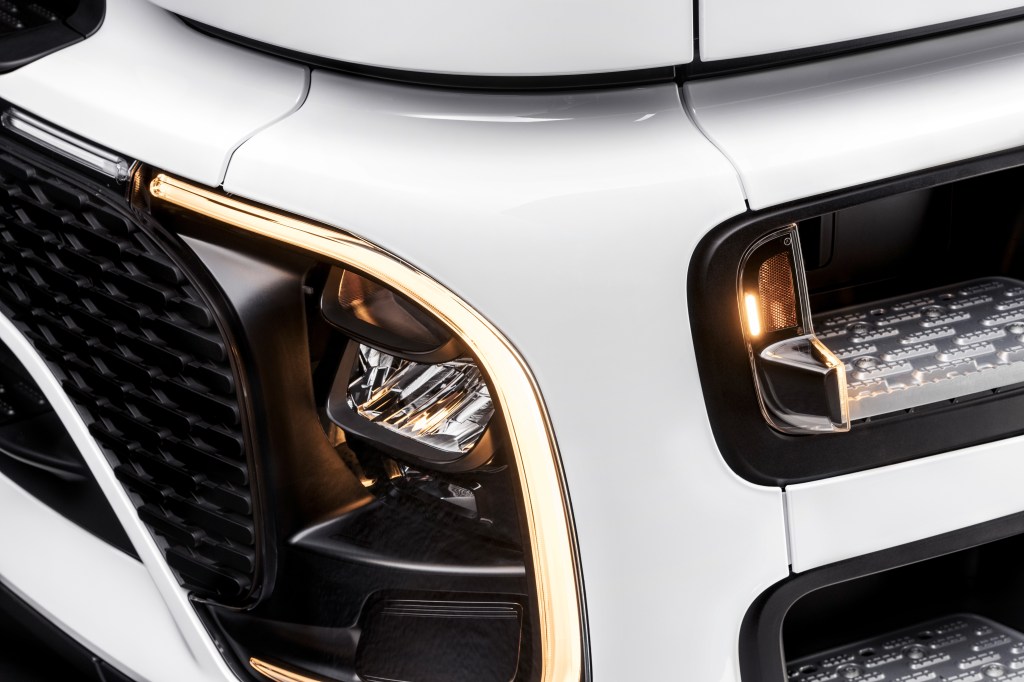
Visually, the truck adopts a new, puristic design with clear lines and an aerodynamic shape. The cab, marketed under the name ProCabin, features a large, fully closed and rounded front hood, an optimised bumper with underbody panelling, improved driver access and extended end flaps shaped like sails. Air deflectors on the A-pillars, an additional roof spoiler and a sealed motor compartment complete the aerodynamic package. The cab also gets aluminium step plates, a new headlamp concept with matrix LED headlamps and an LED light strip.
Aerodynamics matter particularly for battery-electric trucks in long-haul work, as air resistance is one of the main factors affecting energy consumption. Lower air resistance also means more energy can be recovered through recuperation, extending range. Extending the front by 80 millimetres helped achieve the new cab’s shape, which was developed through airflow simulations, wind tunnel testing and on-road measurements. The ProCabin’s drag coefficient is nine per cent lower than that of the Actros cab currently in series production.
Batteries and drive technology
The eActros 600 carries three battery packs of 207 kWh each, giving an installed total capacity of 621 kWh. The batteries use lithium iron phosphate (LFP) cell technology, chosen for its long service life. Mercedes-Benz Trucks has designed the truck to match the durability requirements of a comparable conventional long-haul Actros, meaning up to 1.2 million kilometres over ten years of operation. After that period, battery state of health should still be above 80 per cent. LFP technology also allows around 95 per cent of installed capacity to be used, helping deliver more range from the same battery capacity.
A new 800-volt electric axle with two electric motors and a four-speed transmission has been developed specifically for heavy-duty long-haul transport. The motors produce a continuous output of 400 kW and a peak output of 600 kW, with full motor output available most of the time and almost no interruption in torque.
Recuperation allows electrical energy to be fed back into the batteries during an anticipatory driving style, and it also reduces strain on the brakes. Drivers can choose between five recuperation levels, and one-pedal driving can optionally be enabled via the touchscreen in the digital cockpit.
The truck also features Predictive Powertrain Control (PPC), tuned for the electric drive system. The system automatically accounts for topography, the course of the road and traffic signs to encourage the most efficient driving style, and now incorporates route information from the navigation system to better anticipate conditions ahead. This helps avoid unnecessary braking, accelerating and shifting so battery energy is used as efficiently as possible.
Quiet operation and safety
The eActros 600 is quiet on the road, and an external Acoustic Vehicle Alerting System (AVAS) sounds for forward and reverse travel so pedestrians and cyclists can notice the truck. The sound varies with vehicle speed and accelerator pedal position to aid perception in urban traffic.
The safety concept builds on further development of existing assistance systems, underpinned by a new electronics platform that uses sensor fusion to merge radar and camera data. The platform offers 20 times higher data processing, while six sensors — four short-range radars, one long-range radar and a multifunction camera in the windscreen — cover an angle of 270 degrees around the vehicle. As with previous vehicles from the manufacturer, the installed safety assistance systems go beyond legal requirements in many areas, including the EU Commission’s General Safety Regulation, which from mid-2024 requires additional systems as standard equipment on all new vehicles.
Running costs and profitability
The time needed for fleet operators to reach cost parity with a comparable diesel truck varies by country, depending largely on electricity and diesel prices and toll systems. In large transit countries such as France and Germany, low electricity prices and the planned CO2-based truck toll respectively have a positive effect on operating costs. The eActros 600 can be more profitable than a diesel long-haul truck within an average vehicle holding period of around five years, or after around 600,000 kilometres, despite a purchase price around two to two and a half times higher than the diesel equivalent. Government subsidies for electric trucks and charging infrastructure are a key lever in ramping up the market. More than 80 per cent CO2 savings compared with diesel trucks are possible over the entire life cycle.
Production and availability
Sales of the eActros 600 begin this year, with the start of series production planned for the end of 2024. Alongside the tractor unit, Mercedes-Benz Trucks will produce rigid variants from market launch. A fleet of around fifty prototype vehicles is currently being built, some of which will go into practical testing with first customers.
Karin Rådström, CEO of Mercedes-Benz Trucks, said the eActros 600 stands for the transformation of road freight transport towards CO2-neutrality like no other truck with a three-pointed star, describing it as characterised by highly innovative drive technology that can offer customers particularly high energy efficiency and thus profitability, making entry into e-mobility more attractive for fleet operators.
The eActros 600 will be built on the existing assembly line at the Wörth am Rhein plant, the largest truck assembly site for Mercedes-Benz Trucks, alongside trucks that will continue to use diesel drive. Electric drive components will come from the manufacturer’s plants in Mannheim, Gaggenau and Kassel, all of which are undergoing a transformation into competence centres for emission-free transport. Assembly at Wörth takes place in several steps, including installation of the electric axle, high-voltage batteries and the front box, a complex technology module containing control units, high-voltage components and an electric air compressor. Once all high-voltage components are installed, the entire system goes into operation and the truck is ready to drive.